



Machiavelli was the third child to parents that were thought to be descended from the old marquises of Tuscany. Receiving formal education when growing up, Niccolo was unfortunate to be born during a period where there was constant political turmoil in the region of Florence. He eventually worked in an office of the second chancery, before carrying out diplomatic missions in Rome. Not long after, he was responsible for the Florentine militia which eventually led to the fall of the Florentines and was left in exile. Of course, this experience left a huge impact on Machiavelli’s views and could be said to have influenced his political writings.
A popular quote that Niccolo Machiavelli wrote was that “Since love and fear can hardly exist together if we must choose between them, it is far safer to be feared than to be loved.” Niccolo Machiavelli believed that the well-being of one’s state should be the sole responsibility of the ruler and that includes means such as deceptions and treacheries. Niccolo Machiavelli deemed the ruler’s morality to be lesser than that of the state because only then would it be able to rule effectively. It doesn’t matter if a political leader is friendly, kind or understanding, if they’re not able to do what needs to be done to achieve greatness in a country, then they are not competent.
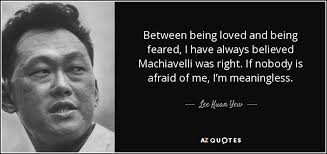
His belief is that men or rulers should not bear the burden of recourse nor justice because all that matters is the end result of a state. Machiavelli reasons this by saying that the masses are merely concerned with appearances and the outward affairs that a state presents, and will be contented with that alone. Together with his knowledge in military theory, he arrives at a conclusion that political life is mostly a conspiracy by the top leaders.
In a sense, it could be seen that most of Niccolo Machiavelli’s ideals and beliefs are strongly correlated to how politics works in Singapore. Similar to Machiavelli's belief in the military, Singapore implements conscription on all males instead of relying on mercenaries as both leaders believe that a fickle allegiance would be unreliable. In terms of politics, the government in Singapore rules with an iron-clad hand, with rules that may seem absurd in other parts of the world. Laws such as the ban on chewing gum or vandalism and graffiti on public properties are met with harsh punishments so as to instil a sense of discipline and social responsibility in the country. Without a doubt, this has worked extremely well judging by how Singapore has evolved into the “garden city” with streets free of litter and security of the highest order.
The final similarity between Machiavelli’s works is how he views sectarian ruling of the country to be most efficient. As he puts it, “being a good Christian, does not equate to being a good leader” and that holds true for a multi-racial country like Singapore where laws are just and free from any religious bias.
We may choose to love or hate Niccolo Machiavelli, but his works are undoubtedly a source of knowledge for us to tap into in a time where political chaos remains rife, hundreds of years after his death.